

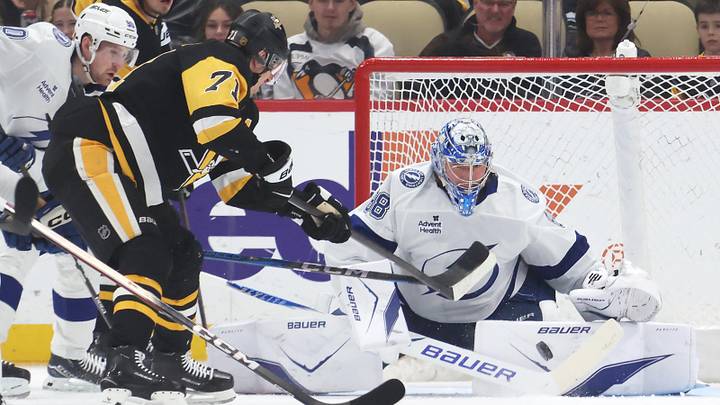
Squint hard enough and you can see the Tampa Bay Lightning's future playing out in Pittsburgh, with the Penguins trying to navigate an internal youth movement while still doing right by their star players. There is no question that Pittsburgh's trio of Sidney Crosby, Evgeni Malkin and Kris Letang will be remembered for generations to come. Finding a few franchise icons like that all at once is the dream of every general manager league-wide.
This is what it looks like when a scorched Earth rebuild goes right. When the ping-pong balls fall a team's way a few times, and Hall-of-Fame caliber talent happens to be available in the draft. The Penguins are further along in their downward swing than Tampa, but the Lightning aren't getting any younger and could lose at least one important free agent in the coming weeks.
There are still some great pieces in place, and neither the Lightning or Penguins have veterans who will go quietly into that good night. Still, the way Pittsburgh general manager Kyle Dubas navigated the choppy waters created by Malkin's resurgent seasons is worth a closer look. After all, his Lightning counterpart in Julien BriseBois will be handling similar situations with the likes of Nikita Kucherov and Victor Hedman, both on the wrong side of the aging curve.
Penguins had a plan and then deviated from their course as new data became available
Reports last summer indicated that Dubas had already decided to move on from "Geno." The GM was going to have to make the difficult call eventually, and with the playoff window in Pittsburgh seemingly closed, that time seemed to be coming this summer.
Then something miraculous happened in Pittsburgh. The team collectively turned back the clock while getting timely contributions from the young players Dubas wanted to focus on, starting this summer. The Ben Kindel pick took all of six weeks to look like a steal, and Malkin had a remarkable bounce-back season for the Penguins.
Dubas had a plan. Then Malkin had a point-per-game season at 39, and developed instant on- and off-ice chemistry with December trade acquisition Yegor Chinakhov. The lesson for BriseBois and the Lightning here is that it's okay to shift course on plans for aging veterans as new information becomes available and situations develop.
The Penguins could have stubbornly stuck to their guns, allowed Malkin to sign elsewhere as a free agent, and created cap and roster space. The opportunity cost of doing so, though--an angered fan base, a disrupted locker room, Chinakhov without his running mate, and Evgeni not getting to properly say goodbye to Pittsburgh--eventually was too high.
When dealing with the staples of Tampa Bay's Stanley Cup teams, BriseBois will have to contend with a lot of the same pressures. Remembering how Dubas navigated this situation with Malkin could serve the organization well, as it isn't every day that a lifer/living legend/future hall-of-famer is working through how he wants to walk away from the game he loves.
Penguins did the right human thing, even if it wasn't exactly the best hockey thing
The NHL, and pro sports in general, are results-based businesses. There generally isn't room for sentimentality, but there are levels to things. Looking even further out West, the most extreme example is the Vegas Golden Knights, where it seems that there is not consideration for The Heart of the Thing when it comes time to wheel and deal.
While it's tough to argue with Vegas' results, the team's press releases are also sometimes soulless enough to make one's stomach turn. Dubas could have taken things to that extreme with Malkin and chose not to. Not only that, the organization decided to give Malkin a deal benefitting a player of his caliber, while also keeping their own books in order.
Again, there's something for the Lightning to learn here: there are clever ways to keep a player from feeling disrespected by lowball offers while incentivizing them for performance. Dubas flatly offering Malkin a take-it-or-leave-it offer in the $4 million range likely leads to a messy divorce. Instead, he's getting an important veteran back at a decent cap hit with a contract in place that should keep Malking driven all season long.
The Lightning have one of the best management groups in all of hockey. None of this is to say that
BriseBois has to learn from anyone. But as the offseason for the Lightning grinds to a halt, this situation with Malkin seemed worth viewing through Lightning-colored glasses. After all, this franchise will be in a similar enough situation soon enough.
 Add us as a preferred source on Google